
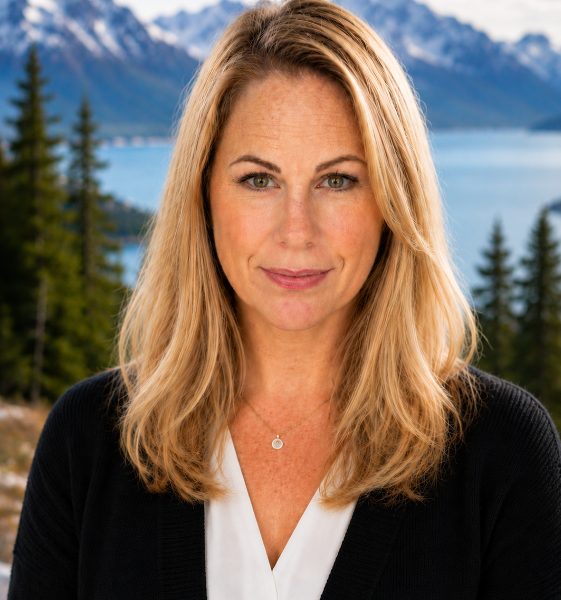
Long before changing her name and swapping her wardrobe for a long, white nun’s habit, former Alaskan Rhia Viens, now 30, had an inkling that the religious life might be in her future.
The second of eight children, she was raised and homeschooled in an active Catholic family in Eagle River, where the family attended St. Andrew Church.
By the time she began high school she was beginning to seriously discern a call to the religious life. For two years after high school she lived at home and traveled to various communities, praying and discerning whether God was calling her to become a religious sister.
Ten years ago this past February, she formally entered religious life and soon changed her name to Sister Mary Rose of the Immaculate Conception.
Earlier this year, she agreed to answer questions from the Catholic Anchor about her vocation journey. The answers have been edited for space and clarity.
How did you discern a call to the religious life?
SISTER MARY ROSE: My call began as a little girl. I was interested in becoming a nun ever since I knew they existed. I always thought I would either be a mother and raise a family or else be a nun.
Was it difficult to give up marriage and a family for the religious life?
SISTER MARY ROSE: Because I had grown up in a wonderful family the prospect of having a family of my own was a very positive one. However, as my teenage years progressed I continually felt a sort of tugging at my heart — a constant feeling that the Lord wanted me for his own. Stories of the lives of the saints inspired me, especially those of consecrated religious such as Saints Rose of Lima, Catherine of Siena and Margaret Mary Alacoque.
The decision to give up marriage and children of my own was made easily enough, for when the Lord asks a sacrifice of us he also gives us the grace to carry it out. I also have the consolation of spiritual motherhood and the truly spousal relationship with Jesus. All consecrated religious are brides of Christ, and through our union with him we bring forth spiritual children — souls who are saved and brought back to the life of grace through our prayers and sacrifices. We are indeed mothers of souls and each year all the sisters wish each other a happy Mothers’ Day.
One catalyst toward the religious life was actually the terrorist attacks of 9/11 when I was 16 years old. For the first time I thought seriously about death — how it can come for us at any time, young or old. What would I do differently if I knew I would die soon? I would want to draw closer to God, to live as he desired me to live and to begin doing here on earth what we will be doing for all eternity — that is loving, praising and adoring him.
Another factor was a friend who entered a religious community. As we wrote to each other I remember comparing her letters with mine. Hers were about God and her service and devotion to him. My letters described my life and hobbies and I realized that I was living for myself. It struck me clearly one day that all I have and all I am is from God.
I realized as did Saint Therese that “love is repaid by love alone,” and such boundless goodness on the part of the Lord toward me merited nothing less than my all. For me that developed into a religious vocation.
When did you enter religious life?
SISTER MARY ROSE: When I gradually became convinced that I was indeed being called to religious life in community, I was faced with the difficulty of discovering where. I did not know where to begin, except at our own cloistered monastery in Anchorage with the Sisters of Perpetual Adoration. As a girl my mother often took me there for adoration or Mass. Seeing the nuns made a great impression on me. I imagined what it would be like to live there as one of them.
I spent a weekend with the nuns but one difficulty was the difference in background, for though some of them were fluent in English, I had no Spanish and it would have been a strain to live in a community where one cannot communicate freely with all of the members.
In 2003 I visited a friend in Florida and went on a miniature pilgrimage of monasteries and shrines in Florida and Alabama. During the trip we visited EWTN as well as the religious community of Mother Angelica, the Poor Clares of Perpetual Adoration.
I was amazed by the beauty and the reverence and traditional bent of the Holy Mass with the nuns. I contacted them as soon as I returned home. The nuns welcomed me for a vocational visit, during which I expressed my desire to enter and they accepted me on Feb. 11, 2004. Thus began my first experience of religious life, one of great joy and discovery of the beauty and tradition in the Catholic faith that I had not known before. I felt very much at home, which is one of the surest signs of a good fit. There were a great many young sisters of my own age and interests, as well as the older nuns whose experience and steadiness gave balance to the community.
Where do you currently serve?
SISTER MARY ROSE: My religious community, the Benedictine Daughters of the Divine Will, is a new religious community in the Diocese of San Marino-Montefeltro, Italy.
So how did you go from Alabama to Italy?
SISTER MARY ROSE: Mother Angelica had already suffered her stroke by the time I entered and she was unable to live the full rigor of the daily schedule. But her spiritual presence as mother of the community was constantly felt.
The novice mistress and mother vicar at that time was Sister Mary Catherine. She introduced me to the writings of Luisa Piccarreta, an Italian mystic. In reading her writings my spiritual life took a new turn and developed more rapidly.
In 2005 I received my new religious name, Sister Mary Rose. In 2007 I made my profession of temporary vows, which are binding for one year and renewed annually for five years in preparation for solemn vows which are binding for life.
In 2009, however, we had an election and Mother Mary Catherine was granted a sabbatical to rest away from the monastery. During this time she went on retreat at a Benedictine monastery and discerned a calling to found a new religious order in the Benedictine tradition in Italy, to live, teach and spread the knowledge of God’s divine will. The order would have white habits and be composed of three branches — religious brothers, religious sisters and a third order of laity.
I immediately knew the Lord was calling me to be a part of this. It came as a great surprise to me, for when I entered the cloister in Alabama I never expected to leave. However, the Lord is full of surprises. I look at my years in the cloister as preparation for my call to begin new work outside the cloister.
After leaving Our Lady of the Angels Monastery I met with the other founding members of the new community to help formulate a plan of action. It was a time of intense prayer, discernment and bonding. None of us having ever started a religious community before, we had little idea of where to begin. We thought the first step was to learn the Italian language. Three of us set off for Italy together. Along with studying Italian, adapting to a foreign country and living community life together we were also searching for a bishop open to our project. Near the end of our two-month stay, Bishop Luigi Negri welcomed our fledgling community into his nearby diocese of San Marino-Montefeltro. With approval from Bishop Negri we returned to Italy with long-term visas and began a new phase.
What does your religious life entail? Are you cloistered?
SISTER MARY ROSE: Our primary work is eucharistic adoration. However, the reason for the community is to share God’s divine will with others. This prompted us not to seek enclosure. Therefore we call ourselves “contemplative but not enclosed” — actually a rarity among religious communities.
The absence of a cloister allows us to have a much closer relationship with the people around us and we are able to help draw them to the Lord through participation in our community prayer and adoration as well as simply welcoming them into our home.
Besides prayer, my daily work includes being the community seamstress and making habits for my sisters. I also have garden and yard responsibilities. There is housecleaning and we take turns cooking. Other jobs include answering emails and prayer requests and updating our website (benedictinesofdivinewill.org).
We have about seven hours of prayer each day, including the Liturgy of the Hours, Holy Mass, thanksgiving after Mass, two hours of silent eucharistic adoration, an hour of spiritual reading, the holy rosary and the Chaplet of Divine Mercy. We have four hours of work, two hours of free time, meals in common and about seven to eight hours for a good night’s sleep.
We also help out in various ways in the parish, assisting at the local nursing home for the weekly Mass, cleaning the church and arranging flowers on the altar.
What are the greatest joys of religious life?
SISTER MARY ROSE: Many families have returned to the sacraments and greater practice of the faith through their contact and friendship with us. These are among the greatest joys of religious life, along with the deepening my love of and union with Our Lord, which brings a sweetness beyond any human pleasures.
The community has grown since its beginning, with the addition of our first Italian vocation, another American sister and also an auxiliary member in New York who is not well enough to join us in Italy but offers all her sufferings for us. We expect additional vocations in the near future.
What are the greatest challenges?
SISTER MARY ROSE: One of the great challenges is the long process of death to self. The vow of obedience is a sure and beautiful way of knowing God’s will for me but it is not always easy. Yet, this self-surrender and obedience is necessary in any state of life and a normal part of the journey to heaven. It always brings far greater rewards than living in our human will.
Some worry that religious life controls women and denies their freedom.
SISTER MARY ROSE: The idea that religious are controlled and denied their freedom is certainly fallacious. The decision to enter religious life is always a free choice. Just as with marriage, any coercion negates the validity of the vocation. In a healthy community, the obedience is never exaggerated nor abused.
Poverty, chastity and obedience that Our Lord taught us through his example are not only for religious but for all who desire eternal life and claim to follow Christ.
What would you say to a young woman who has an inkling about a religious vocation?
SISTER MARY ROSE: Do not be afraid! If religious life is for you it will be a path of joy and happiness. Among all the many unique religious communities there is sure to be one that is the perfect one for you. The best way to find out is to go and try it. There are many stages in religious life, especially before making a final commitment. To go and see does not require any final decision, and even formal entrance in a community is only the beginning of greater discernment. If the life is not right for you there is always freedom to leave. It is a fallacy to believe we should stay in a place we are miserable out of penance. If it is not our vocation the worst thing we can do for ourselves and for the community is force ourselves to stay. When you find your true vocation, wherever it may be, it is the place you will be truly fulfilled and become who you were born to be. There is no greater happiness.

'Alaskan-raised nun relates joy of religious calling'
Be the first to comment on this post!has no comments