
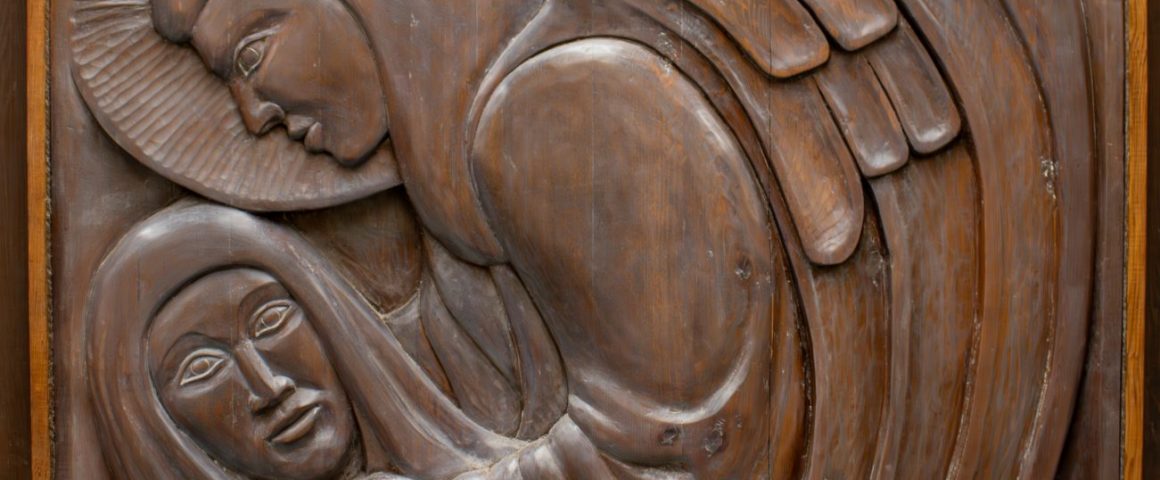
The Feast of the Annunciation was on March 25. We commemorate a significant turning point in not only the life of the Blessed Virgin Mary, but also all of mankind, when Gabriel told her a God Himself would become incarnate, should she freely choose to bear Christ. In the history of art, this moment has inspired countless beautiful works, including some produced in the Archdiocese of Anchorage-Juneau.
Susan Jayich is a parishioner at St. Elizabeth Ann Seton parish in Anchorage. Jayich has given several talks over the years that touch on Catholic art, including art of the Annunciation, at a number of venues, including Holy Spirit Center in Anchorage. Additionally, she has focused on a Catholic method of meditating on art: Visio Divina (sacred seeing in Latin). Like Lectio Divina (sacred reading), Visio Divina is a four-step process that gradually draws meaning from a subject.
The Annunciation is a mystery with too many aspects to compellingly portray in a single work. Artists then must choose aspects to emphasize. In the same way, someone contemplating the mystery can only focus on a few aspects at a time. To properly engage with the mystery, the artist and observer must embrace a humility similar to the Blessed Virgin Mary’s when she expressed her fiat, trusting in God. One such method is Visio Divina:
1. Visio (seeing): carefully examine the composition, color, line, space, texture, and other material qualities of the piece of art to the point you can describe it from memory.
2. Meditatio (reflection): carefully examine the narrative and symbolism of the subject matter in the context of the artist’s intention and sacred tradition. Consider how the work reveals new insights.
3. Oratio (prayer): explore what personal meaning, connection, relationship, and responses you find in the subject. This can be through a story, sacred figure, or mood. Possibly in the form of prayer, become aware of your feelings that surface.
4. Contemplatio (contemplation): let go of the image and contemplate in a wordless, imageless silence.
Lectio Divina was formally instituted by St. Benedict of Nursia in the sixth century. It relies on reading as opposed to seeing. Nonetheless, the three later steps outlined by Jayich’s mentor, Victoria Scarlett, one of the founders of the Center for Sacred Art in Seattle, are the same. Scarlett and Joseph Anderson, also a founder of the center, outlined their conception of Visio Divina in 1999. While pursuing her master’s, Jayich says she met and learned from Scarlett.
“When looking at art, there’s a lot to do with beauty,” Jayich says. “Even with the older pieces of the Annunciation, you can spend hours looking at each stroke in an angel’s wing.”
Art rapidly changes in style, which means the same subject can be rendered in many different ways. The Annunciation has thus been portrayed diversely. One such example can be found locally.
In Anchorage, a 56” tall by 40” wide wood bas-relief of the Annunciation was carved by Jacques and Mary Regat to celebrate the 25th anniversary of the Archdiocese of Anchorage. In 2000, they were invited by Pope St. John Paul II to the Jubilee celebration honoring artists. They wrote that, “Working with intuition and passion, creating works of art, personal visions for the world to see, enables us to better understand what is really important.”
Visio Divina permits deeper understanding of the many mysteries of the faith. The Annunciation, one of the joyful mysteries of the rosary, is multifaceted. In art, the myriad aspects of the stories, figures, and types that intersect at the mystery can be pulled apart and selectively emphasized, consciously or unconsciously, to permit deeper understanding of a fundamentally inexhaustible mystery.
One need only contrast the Regats’ work with the Annunciation by Masolino da Panicale.
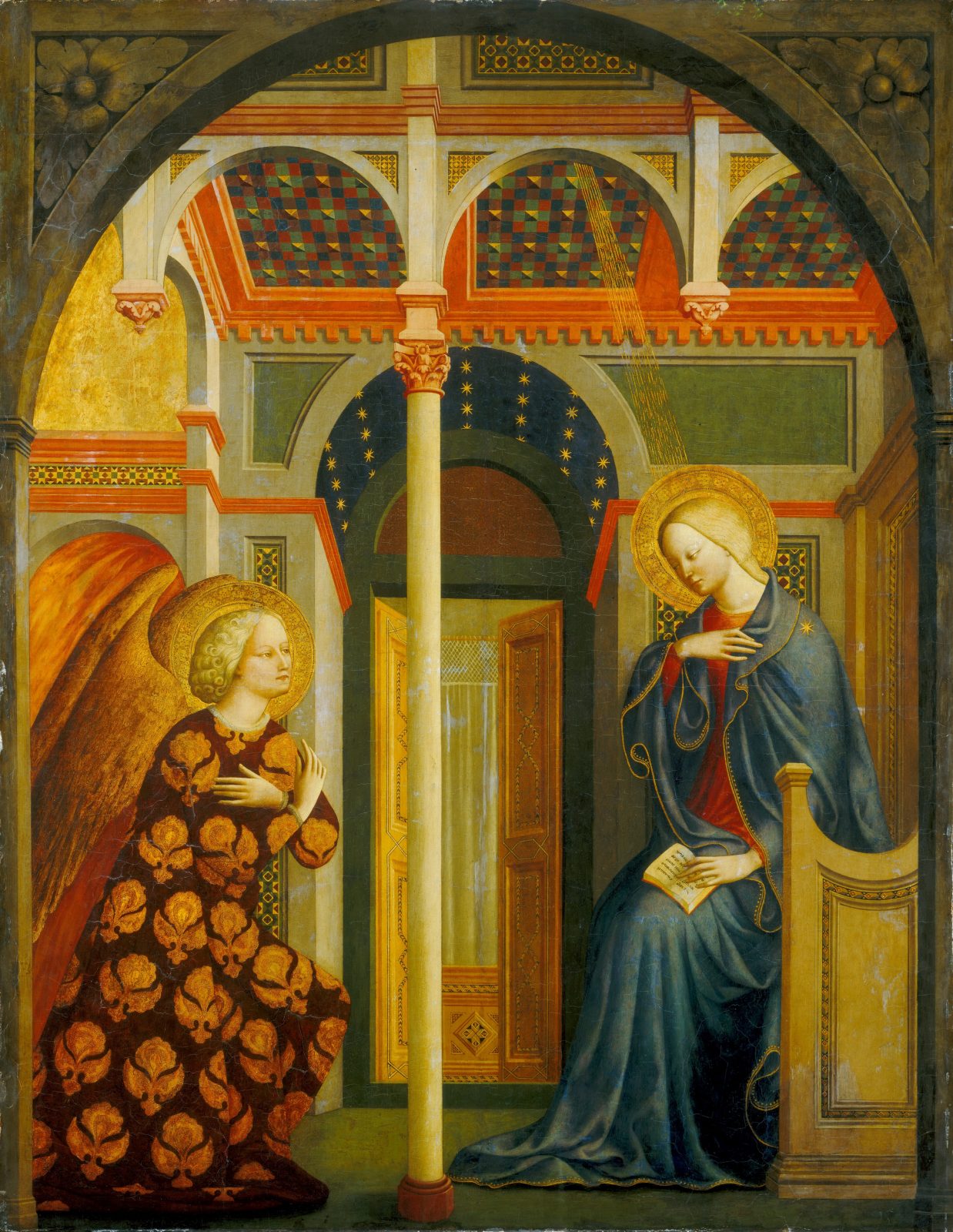
“Annunciation” by Masolino da Panicale, circa 1423–24 (National Gallery of Art)
Da Panicale was an Italian Renaissance painter whose work differs from the Regats in terms of composition, setting, perspective, color, and more. Sticking with the example of the wings, the Regats emphasize them, taking up a majority of the image. Da Panicale portrays them far smaller. Also note da Panicale makes Gabriel lower than the Blessed Virgin. The Regats emphasize the scale of Gabriel, while da Panicale deemphasizes the angel next to Mary. One can imagine Gabriel’s words, “Be not afraid,” may have inspired the Regats’ portrayal to a greater degree than da Panicale, who may have wished to highlight how “full of grace” the Blessed Virgin is in comparison. Even though this is the same story, the different parts can be read or rendered in different lights both producing deeper truth.
We can never fully comprehend the Annunciation, but, through art, Lectio and Visio Divina, and contemplation, we can begin to apprehend the shadows of the full implications of God’s inscrutable activity in the world. Like the Blessed Virgin Mary, humility before God as He shines in all the beauty of the world is the key to contemplation and the key to her fiat, the willingness to allow for His will to be done to us according to His word.


'Looking at the Annunciation in the light of Visio Divina'
Be the first to comment on this post!has no comments