

Behold, you will conceive in your womb and bear a son, and you shall name him Jesus. —Luke 1:26-38
Long before people could read, art told the story of Jesus. Adorning churches and other religious buildings for centuries, Christian art not only enhanced the beauty of sacred space, glorifying God and enriching worship, but also taught the faithful about the life, death and resurrection of Jesus.
On March 25 we celebrate the Solemnity of the Annunciation of the Lord, the moment in which Jesus was conceived by the Holy Spirit and began His human existence. Art that depicts that moment is widespread throughout the world, including Alaska. It is believed that Annunciation art is more numerous than any other Christian subject with the exception of the Crucifixion of Jesus.
We know the story. The Archangel Gabriel appears to the Virgin Mary and announces that she will conceive by the Holy Spirit and bear a son who will be called the Son of the Most High, and his kingdom will have no end. This greatly troubled Mary, and she seemed confused and even afraid. The angel reassured her, and through what had to be absolute trust and faith in God, she allowed it to be done. Can you imagine? Artists have done their best to use their imaginations to enter that story for centuries.
The story of the Annunciation has been painted, drawn, sculpted and carved throughout the ages and in many different styles, from rough fourth century drawings on Roman catacomb walls to the highest Renaissance art and finally to contemporary twenty-first century renderings. These images have served people with a visual representation of the sacred and awe-inspiring moment of the inbreaking of God into human history: Jesus becomes man through the virtue, humility, trust and faith of Mary.
To tell the story of the Annunciation, artists have used the language of symbols to communicate theological ideas. Annunciation paintings, particularly from the Middle Ages and Renaissance, are filled with symbolism that the people of the time would have understood.
Some of these symbols include: the lily flower held by the angel or in a vase symbolizing the purity of Mary; a pillar or column or line on the floor separating Gabriel from Mary that symbolizes the separation of the divine from human and the old covenant giving way to the new covenant; a book being read by Mary that is thought to be Isaiah 7:14 predicting the birth of Jesus; a darkened window or doorway leading to an interior space that is thought to be symbolic of Mary’s virginity; an enclosed garden filled with flowers, such as daisies, violets, roses and others flowers symbolizing Mary’s purity, virginity and other virtues; and a bird symbolic of the Holy Spirit.
Mary frequently is depicted either with her hands raised or outstretched or crossed against her chest and head bowed. When her hands are raised the artist is depicting the moment she first hears the angel’s message and is “greatly troubled”. When her arms are crossed and head bowed, she has agreed: “May it be done to me according to your word.”
One of the most popular depictions of the Annunciation is Leonardo da Vinci’s painting from 1475. Another is the “Cestello Anunciation” by Sandro Botticelli.

“Cestello Anunciation” by Sandro Botticelli.
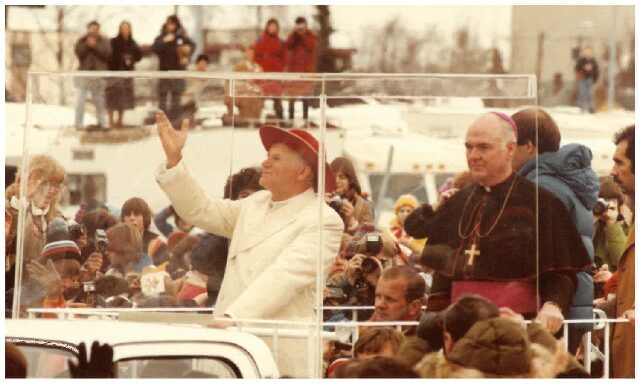
Much loved images were also painted by Fra Angelico and Fra Filippo Lippi. These artists represent the fifteenth century Italian Renaissance, but there are many more painted by Northern Renaissance masters as well. Modern artists such as John Collier and Henry Ossawa Tanner are worth exploring. Our own archdiocese has produced local art of the Annunciation as well, including a bas relief carved by Jaques and Mary Regat in 1995, celebrating the Archdiocese of Anchorage’s 25th anniversary. Their 56” tall by 40” wide wood bas-relief now hangs in the archdiocesan chancery. In 2000, they were invited by Pope St. John Paul II to the Jubilee celebration honoring artists.

This carving by Jacques and Mary Regat hangs in the Archdiocese of Anchorage-Juneau chancery.



'Celebrating the Annunication in Art'
Be the first to comment on this post!has no comments