
 CatholicAnchor.org
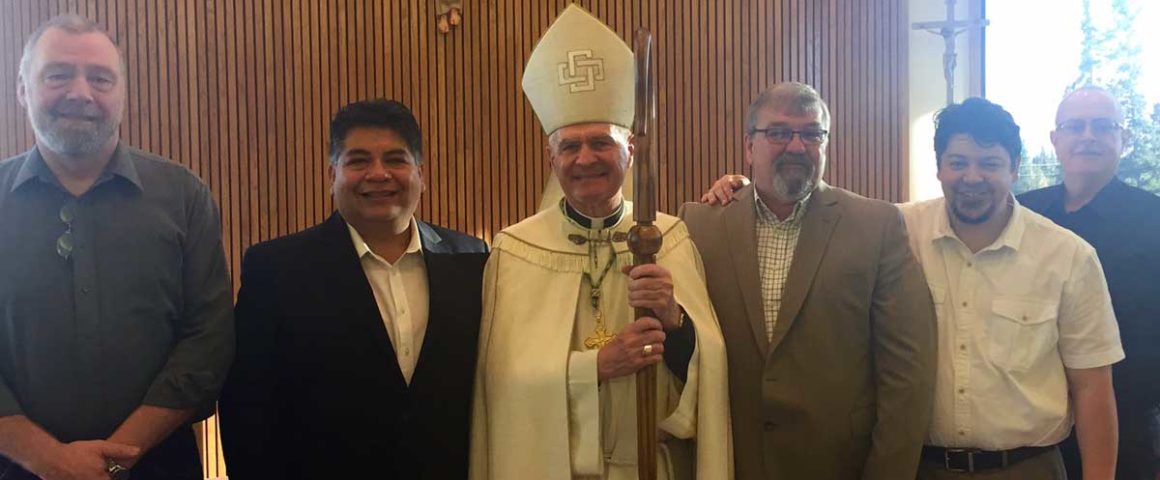
On Sept. 17, five men participated in the Rite of Lector, one of four liturgical rites on the way to being ordained as permanent deacons for the Archdiocese of Anchorage.
The first step was Rite of Candidacy, followed by the Rite of Lector. Upcoming rites include the Rite of Acolyte and finally ordination to the permanent diaconate in 2018.
During the recent celebration at Holy Spirit Center in Anchorage, the five men were formally installed as lectors, meaning they are now equipped and able to read Sacred Scripture during the liturgy.
“The Holy Scriptures play a foundational role in our life as Catholics,” said Deacon Mick Fornelli who is tasked with overseeing the formation of deacon candidates for the archdiocese. “Ultimately, as deacons, these men will be ordained to preach the Gospel.”
The men training to become permanent deacons are Scott Gunnell, Gustavo Azpilcueta, Dan Winters, Gabriel Ruiz and Michael Hawker.
In an email to the Catholic Anchor, Deacon Fornelli noted that the life of a deacon, like bishops and priests, is rooted in God’s word.
“As ordained we make a promise to pray the Liturgy of Hours daily,” Deacon Fornelli said. “This formal prayer of the church is primarily founded on all 150 psalms, as well as other Scripture and readings of Church Fathers, Church Councils and the saints.”
“The last group of permanent deacons — a group of six men — was ordained in 2015 with the exception of Deacon David Van Tuyl who was ordained in May 2016, bringing the number of deacons to 17 in active ministry, along with four retired deacons who serve as needed and three deacons from other dioceses who serve the Anchorage Archdiocese.”
“As an archdiocese, we are blessed to have men, both deacons and priests, who have dedicated their lives to serving God’s people and we are blessed to have these five men so generously giving of themselves through this lengthy formation process toward ordination to the diaconate,” Deacon Fornelli said. “Please pray for them, that they continue to grow in their love for God’s Word, for Christ, and God’s people.”
Discernment for the diaconate is a five-year process that culminates in ordination.
Since most deacons are married, the bond which he and his wife have developed in the sacrament of marriage is seen as the impetus of the married deacon’s ministry to the wider community he serves. For this reason, wives of married candidates are encouraged to attend classes so that together the couple may determine if this is the right time to pursue this ministry.
Once ordained, the deacon enters a new relationship with his bishop, with those to whom he ministers and the laity from whose ranks he comes.
As an ordained minister, the deacon is seen as a servant to the wider community. Service characterizes the ministry of deacon and is a distinctive mark from the ancient days of the church. The deacon, by his ordination is a symbol of the three paramount areas of the church’s life: word, sacrament and service.
Deacons have a number of roles within the liturgical life of the church. These include announcing the penitential rite; proclaiming the Gospel; preaching homilies, speaking the Prayers of the Faithful, assisting with eucharistic gifts, serving as an ordinary minister of the Eucharist, purifying the vessels after Holy Communion and dismissing the faithful at the conclusion of Mass.
Outside of the liturgy, deacons take on other roles. These may include administrative work such as managing parishes when there is no priest available; ministering to the sick, aged and poor; ministering to those with drug or alcohol problems and people in prison. Other roles include teaching, sacramental preparation and assisting in funeral services.
Deacons cannot consecrate the Eucharist, hear confessions or administer the sacrament of the anointing of the sick. These ministries are reserved to ordained priests and bishops.
Generally, deacons are volunteers and not paid for their ministry.
Deacons were very powerful in the early church, and many eventually became popes.
Beginning in the third century confusion between the role of priests and the role of deacons led to the decline of the diaconate. By the fourth century, bishops were delegating priests to preside in their place at Sunday Eucharist.
As priests took on many duties formerly performed by deacons, the deacons became assistants to priests. Eventually, the deaconate came to be seen as a step on the path toward ordination as a priest, leading to the transitional diaconate.
By the Middle Ages, the diaconate had nearly disappeared.
The Second Vatican Council restored the permanent diaconate in 1964.
Deacons are one of only three groups of ordained ministers within the Catholic Church, the others being bishops and priests. Deacons may be single or married and must be at least 35 years old in the United States.


'Five Alaskan men advance towards becoming permanent deacons' have 2 comments
October 2017 @ 3:34 pm Gus Azp
Scott Gunnell of Sacred Heart Church in Wasilla; Gus Azpilcueta of Holy Family Cathedral in Anchorage; Dan Winters of St. Christopher by the Sea in Dutch Harbor; Gabriel Ruiz of Our Lady of Guadalupe Co-Cathedral in Anchorage; and Mike Hawker of St. Elizabeth Ann Seton Church in Anchorage.
October 2016 @ 1:55 pm tim
What are the names of the five men?