
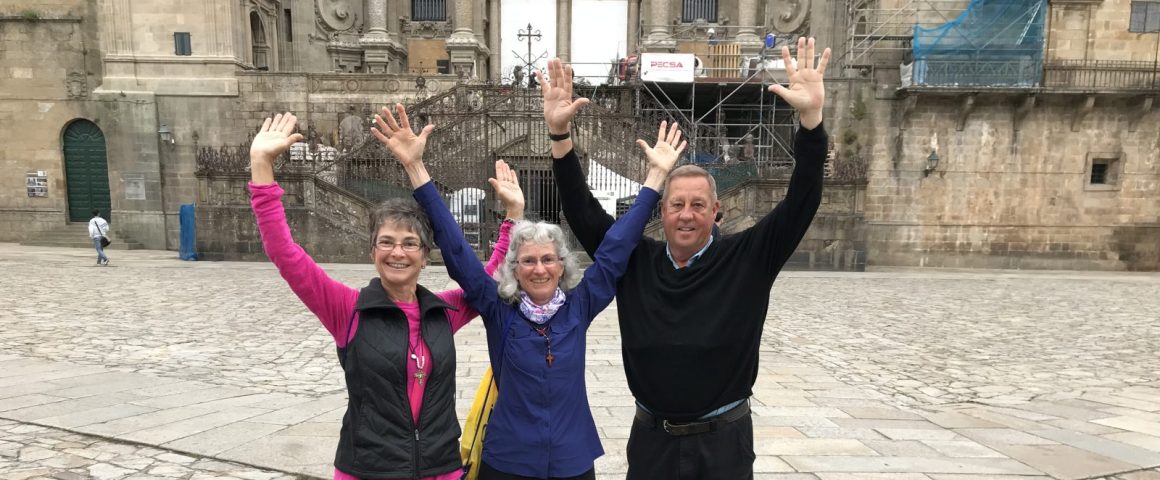
El Camino de Santiago (“The Way of St. James”) is one of the oldest pilgrimages in the Catholic Church. The pilgrimage began in the 9th century with a king’s journey to validate a hermit’s claims of finding the bones of St. James at Compostela in Galicia, the northwestern region of Spain. Pilgrims from all over the world have followed in the king’s steps to Santiago de Compostela since. 200,000 pilgrims visit the shrine annually to do penance, offer thanksgiving, and grow in holiness. Alaskans are among those pilgrims.
Some priests of the Archdiocese of Anchorage-Juneau have walked the Camino, including Fr. Mike Galbraith, Fr. Scott Garrett, Fr. Joseph McGilloway, and more. Many Archdiocese of Anchorage-Juneau parishioners from different walks of life joined this pilgrimage as well, including Nancy Anderson, Peggy Mattson, Michelle Leibold, and Julie Galligan.
Nancy Anderson of Seward recollected her own pilgrimage: “One of the most emotional feelings for me was the quiet time spent in the many churches we visited, and the invitation to attend Mass at a monastery with only the sisters and attending priest in the chapel. Mass and singing was all in Portuguese, but being the only guests invited in was quite powerful and moving… no matter the language, the Mass was the same.”
Peggy Mattson of St. Paul the Apostle parish in Juneau made the pilgrimage with Fr. Galbraith, Shelly Tradel, Bernadette Franulovich, and Mattson’s sister, Mary Shoenberger, in 2018. She recounted the vineyards, fields of red poppies, the “whispering sound of God in the chorus of songbirds,” and the oscillation between the hot sun and the rain and cool mountain breezes.
“Our 35-day journey started the day after Pentecost, and we celebrated so many liturgical feasts of the Church, including Corpus Christi, Holy Trinity, the Birth of John the Baptist, and the Feasts of the Sacred Heart of Jesus and Immaculate Heart of Mary,” Mattson said.
Mattson noted different ways she was able to connect with Christ, treating all pilgrims and locals as brother and sister, praying the rosary and celebrating Mass daily, and being aware of the spiritual heritage of the pilgrimage, the many saints, such as St. Francis of Assisi, who took the route.
Mattson called each step a prayer: “Some days we would choose an alternate route, the road less traveled, and were twice blessed, even though it was a little longer. If we were ever lost or needed directions, we always encountered an angel to direct us.”
Michelle Leibold, who attends Mass at Holy Spirit Center in Anchorage, traversed the pilgrimage twice with her husband, once on the original French route in 2023, then the northern route in 2025, which takes pilgrims along the northern Spanish coast.
“I read about it online for years and was interested in doing it, but I have knee issues. While I can hike 5-10 miles or more in one day, I can’t do it day after day,” Simpson said. After she learned the routes could be cycled, she and her husband decided to go on pilgrimage a year later.
She said she wanted to do the pilgrimage “for religious searching, for a physical challenge, and to do something totally different from normal sightseeing travel.” She said her experience interacting with other pilgrims was “amazing. Everyone is equal. People are very helpful and giving. I saw no prejudice, no judgement. We enjoyed staying in albergues (hostels for pilgrims) the most. Staying in the albergues gave us more interaction with other pilgrims.”
Leibold said she stopped to appreciate “magnificent churches like the Cathedral in León.” But she said her favorite churches were the “simple stone churches in the villages, churches built into caves.” She also recalled finding the Prayer of La Faba, her favorite, on a little stone church on a mountain top.
When asked about pilgrimage, Leibold said that “being outside in God’s greatest cathedral with a continual reminder of his power, the effect Jesus had on this world and the lengths people go and have gone to practice and apply their faith is overwhelming. In a pilgrimage it seemed like I was always communicating with God and had constant reminders of him. In life at home, it is easy to get caught up with business, work, news, daily issues, and not putting God first in your life.”
Julie Galligan walked the Camino with her sister in April 2024. She considers the Camino a metaphor for life.
“Once you step onto the path, you never know what — or who — you will encounter,” Galligan said. “People choose to walk the Camino for many reasons, but every pilgrim is moving toward the same destination, putting one foot in front of the other while sometimes coping with leg cramps, injuries, or blisters. Along the way, there were priests and nuns in full habits, joggers, baby strollers, children of all ages, and older adults.”
Similarly to Leibold, Anderson, and Mattson, Galligan noted the camaraderie she felt with the other pilgrims, sharing “stories, meals, prayers, struggles, laughter, and tears.” She said, “The slowness and intentionality of walking allowed you to take in all of God’s majesty and the breathtaking masterpiece of Spain’s beauty.”
Galligan said, “It is hard to put into words what you experience on a journey like this. Because no matter how or what you say, it just does not seem to express what is in your heart.”
The Way of St. James is transformational, whether a pilgrim takes the route from France, England, Portugal, Spain, or Germany; as the landscape and cultures change with each step, so progresses the grace of God in a pilgrim’s soul, regardless of the soul’s starting point, as the pilgrim draws closer to God.
'Alaskan pilgrims share Camino de Santiago experiences'
Be the first to comment on this post!has no comments