
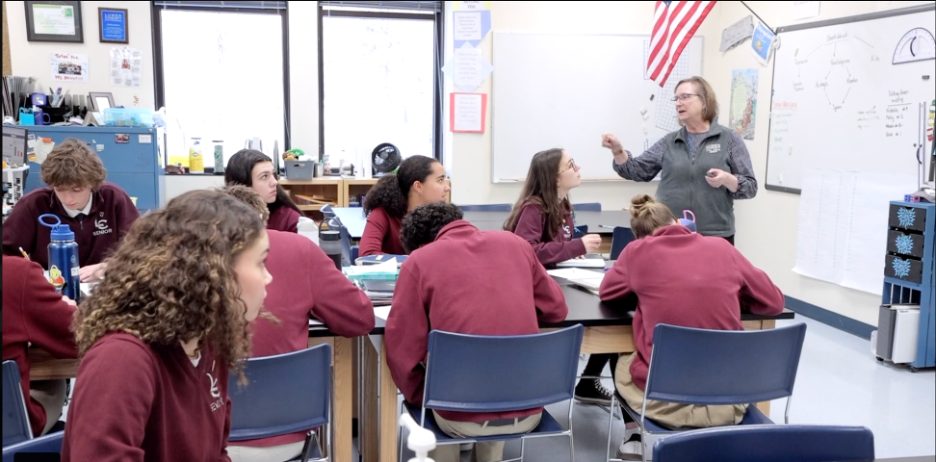
When Debbie Brewer first heard from a fellow teacher about a brand-new Catholic school opening in Anchorage, she made a phone call on a Sunday afternoon. By that evening, she had a job. School started Tuesday.
That spontaneous beginning turned into one of the most enduring partnerships in Lumen Christi Catholic High School’s history. Now three decades later, Brewer is stepping away from the school she helped build from the ground up — and the Anchorage community is all the richer for everything she poured into it, said Fr. Tom Lilly, the school administrator and pastor at St. Benedict parish.
Lumen Christi opened its doors in 1996 with just 33 students. Brewer, who grew up on the East Coast as a Navy kid, studied biology in Colorado and finished her teaching certificate after making Alaska home. She taught both full-time and as a long-term substitute for over 10 years, including in some classrooms packed with over 35 students. She was deeply passionate about science — and that turned out to be exactly what the fledgling school needed.
Over the decades, she built a science program that became one of Lumen’s signatures. She taught biology, chemistry, forensic science, and biotechnology, along with geometry — which she calls “the most fun math class to teach.” Her forensic science course became a school legend, challenging students to work mock cases from fingerprint analysis to DNA evidence, eventually arguing their findings in a simulated courtroom. Investigating the mock crime scene and seeing the students present evidence to a mock jury in front of members of the student body was one of the highlights of the forensics class.
Another unique contribution to the school came when Brewer collaborated with the biotechnology company Geno-typ to make Lumen Christi the first school in the nation to pilot a landmark bioscience curriculum. The curriculum reflected her core philosophy that “good science requires a strong moral background” and that faith and science are deeply compatible in the pursuit of truth. On May 19, Brewer was honored by the Thirty-Fourth Alaska Legislature for these and other accomplishments, and her exemplary career in the classroom and beyond.
In the past, she taught at a forensic science camp sponsored by FOAST, (Fraternal Order of Alaska State Troopers), served on the DARE Alaska (Drug Abuse Resistance Education) Board of Directors as educational advisor, and conducted research at The University of Alaska Anchorage as part of the Murdock Partners in Science Program. She also served on the COGNIA (accreditation) advisory board and as a clinical supervisor of new teachers for Western Governors University.
Possessing all this background in her profession set Brewer up to teach some serious material to her 12-18-year-olds. But for Brewer, the subject matter was never really the point.
“My goal isn’t that students learn all the parts of the cell,” she says. “I want them to learn how to do science. How to be problem solvers. How to be good consumers of information and make moral decisions.”
Fr. Lilly, who teaches the bioethics courses, said he built on her knowledge. “I hold teachers in the highest esteem. When I was a brand-new teacher, I sought Debbie’s advice on what she considered of paramount importance in the classroom: She responded, ‘When I’m frustrated with a student, I ask myself, what sacrifice can I make in this situation in order to help this student reach the potential I know they have in the future?’”
Brewer’s “truly a master teacher and it has been an absolute pleasure for me to be her student,” Lilly said.
She also served as senior advisor and dean of academics, watching junior high students she first met as nervous twelve-year-olds grow into remarkable young adults. “They come in so young,” she says, “and it’s just great to watch them become really amazing young people.”
In 2012, Brewer was diagnosed with cancer. She underwent chemotherapy, supported throughout by colleagues who, she says, held her hands through every difficult moment. She has been healthy for 14 years. “Once you do that,” she reflects, “every day that comes after is another gift.”
That gratitude shapes how she talks about Lumen Christi. The school now enrolls around 140 students — a far cry from those original 33 — and Brewer has watched it grow in academics, in faith integration, and in the depth of its community. She speaks of her colleagues not just as talented professionals, but as servant leaders and good people who live their faith every day.
As for what’s next: she doesn’t know. There’s talk of getting on the substitute list, attending special events, and most importantly, spending more time with her four grown children and five grandchildren spread between Alaska and the Lower 48.
“I don’t know why people aren’t beating the doors down to work here,” she says. “I can’t imagine a more supportive, positive, and amazing place to work.”
These 30 years later, Lumen Christi came to be that place in large part due to an extraordinary teacher in the lab.


'A life in the lab: A teacher’s 30 years at Lumen Christi'
Be the first to comment on this post!has no comments